
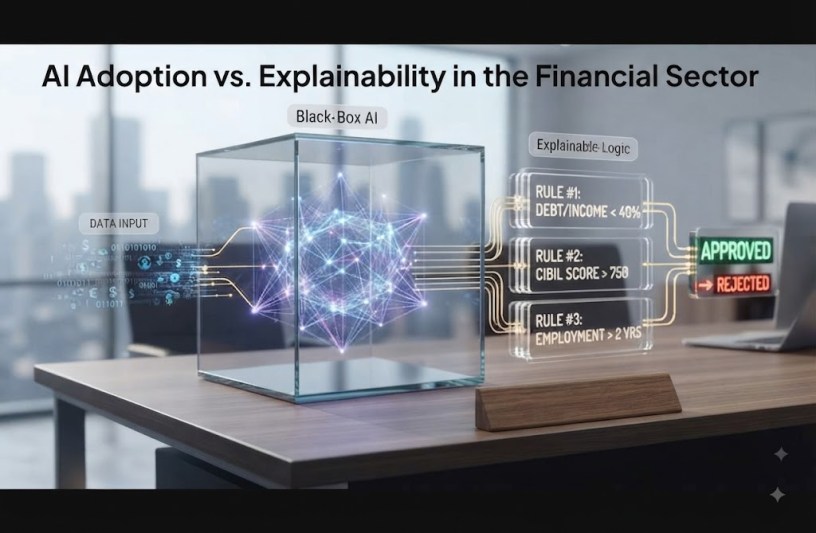
While most industries are racing to adopt AI into their workflows, it isn’t quite that simple for the regulated financial sector. In an industry where people’s livelihoods and hard-earned money are involved, moving fast and breaking things is simply not an option.
Let’s look at why this friction exists:
AI makes decisions based on probabilities derived from massive datasets, learning much like a child absorbs information from its environment. However, humans have an extra layer of lived experience, and no human can exactly document every biological step that led to a decision.
Similarly, we cannot easily trace how an AI reached a specific result because it is driven by millions of arithmetic probabilities. That is why we call it Black-Box AI.
- The Pros: Unsupervised AI can uncover hidden patterns at lightning speed.
- The Cons: In a regulated space, total opacity is a dealbreaker.
When a financial institution denies a loan in credit underwriting, they are legally required to explain why to the applicant, and they must be able to justify their portfolio decisions to regulatory authorities.
So, if unconstrained AI isn’t the answer, how is the industry making decisions data-driven without breaking compliance?
Financial institutions leverage advanced analytics to identify key risk parameters, which are then governed by Business Rule Engines (BRE) to make the final call.
- The Pros: The decision is 100% transparent, auditable, and easily explainable.
- The Cons: Managing thousands of complex “If-Then” conditions requires careful operational oversight and manual intervention when edge cases arise.
The intersection of technology and regulation in banking is a fascinating balancing act, and the way forward is evolving every single day.
Let me know what you guys think—how is your organization balancing the push for automation with strict regulatory compliance?

